
Tighter workflows win.
A single apparel order can mix screen print, DTF and embroidery, blanks from several suppliers and work done by contract decorators. The shops holding their ground are the ones that run the tightest workflows.

Three things the research says.
More with less
Shops focusing on their best customers and running tighter workflows are holding their ground.
Marshall Atkinson, 2026 Thinking (88 operator conversations)Apparel meets promo
Decorators are entering promotional product fulfillment: the same buyer needs workwear and merchandise.
The Integration Gap, section 1Tariffs are structural
Tariff volatility is a planning problem across every segment, not a temporary cost shock.
The Integration Gap, theme 3Four handoffs, every order.
Each one is a person bridging two systems. Each one is a place where orders wait, errors creep in and margin leaks out.
The expensive part isn't the software. It's the people bridging the gaps between the software.
- 01Orders split into decoration jobs by handStandardization
- 02Blank availability checked by phone or portalIntegration
- 03Contract decoration tracked in email threadsOrchestration
- 04Customer asks "where's my order?"Orchestration
Four layers, applied to decorated apparel.
Before and after Atomyx Manage.
Without Atomyx
- Orders split into decoration jobs by hand
- Blank availability checked by phone or portal
- Contract decoration tracked in email threads
- Customer asks "where's my order?"
With 
- One order becomes one job per method and location, automatically
- Supplier inventory and POs linked to the job
- Outsourced jobs tracked in the same view as in-house work
- Customer sees one status, across every method and partner
Every source, one data model.
Whatever arrives, from a storefront webhook to a supplier file, a transformer maps it into the objects you define. Setup is guided by AI through MCP, and every transformer is previewed on real records before it goes live.
Explore transformers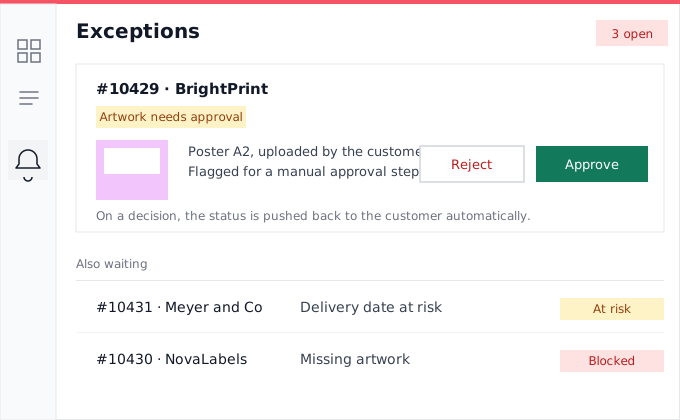
Start with one order.
Map one order from intake to delivery, including every handoff.
Classify each manual step as a standardization, integration, automation or orchestration gap.
Close the orchestration gap first. It is where most of the cost sits, and it makes every other fix worth more.
Map one order flow with us.
A 45-minute Integration Gap Review. We trace one real order from intake to delivery and send you the gap map with a validated saving, whatever you decide.
- Every handoff in one order flow, mapped
- Each manual step classified as a standardization, integration, automation or orchestration gap
- A validated saving, checked against the real order
- A clear first move, with or without Atomyx
