
At run length one, every touchpoint is a loss.
Marketplaces and platform partners send orders around the clock, each with its own format and SLA. When an order is worth a few euros, a single manual step wipes out the margin.

Three things the research says.
Categories are converging
POD platforms are crossing into corporate gifting and branded merchandise.
The Integration Gap, section 1Backends are consolidating
Consolidation is building ever larger backend networks across adjacent categories.
The Integration Gap, section 1Labor is the constraint
Labor scarcity is the structural driver behind every automation investment.
The Integration Gap, theme 7Four handoffs, every order.
Each one is a person bridging two systems. Each one is a place where orders wait, errors creep in and margin leaks out.
The expensive part isn't the software. It's the people bridging the gaps between the software.
- 01One integration per platform, each maintained separatelyStandardization
- 02SLA breaches discovered when the platform complainsOrchestration
- 03Items routed by operators across print, DTF and sublimationAutomation
- 04Tracking numbers copied back by handIntegration
Four layers, applied to print on demand and fulfillment.
Before and after Atomyx Manage.
Without Atomyx
- One integration per platform, each maintained separately
- SLA breaches discovered when the platform complains
- Items routed by operators across print, DTF and sublimation
- Tracking numbers copied back by hand
With 
- One transformer per platform, one data model for all
- Views and triggers flag at-risk orders while there is time to act
- Rules route each item by product, technique and capacity
- Carrier labels and tracking flow back to every platform
Every source, one data model.
Whatever arrives, from a storefront webhook to a supplier file, a transformer maps it into the objects you define. Setup is guided by AI through MCP, and every transformer is previewed on real records before it goes live.
Explore transformers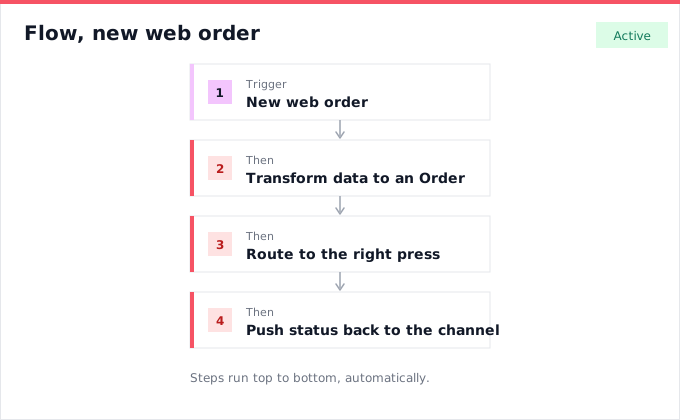
Start with one order.
Map one order from intake to delivery, including every handoff.
Classify each manual step as a standardization, integration, automation or orchestration gap.
Close the orchestration gap first. It is where most of the cost sits, and it makes every other fix worth more.
Map one order flow with us.
A 45-minute Integration Gap Review. We trace one real order from intake to delivery and send you the gap map with a validated saving, whatever you decide.
- Every handoff in one order flow, mapped
- Each manual step classified as a standardization, integration, automation or orchestration gap
- A validated saving, checked against the real order
- A clear first move, with or without Atomyx
