
More channels, thinner margins, same team.
Online print producers now take orders from their own webshop, B2B portals, marketplaces and platform partners. Every new channel adds another order format, another status API and another manual check.

Three things the research says.
Automation is survival, not advantage
2025 was the year existing automation became operationally meaningful across every segment.
Keypoint Intelligence, 2025The storefront may be bypassed
AI agents that brief, price and submit jobs inside a conversation were the central theme at OPS 2026.
Bernd Zipper, OPS 2026Personalization is the baseline
Mass customization is the new default, not a premium service.
PPAI Research, 2026Four handoffs, every order.
Each one is a person bridging two systems. Each one is a place where orders wait, errors creep in and margin leaks out.
The expensive part isn't the software. It's the people bridging the gaps between the software.
- 01Orders exported, checked and rekeyed per channelStandardization
- 02Files checked by hand before they reach prepressAutomation
- 03Status updates sent by email, or not at allIntegration
- 04A new platform partner is an IT projectOrchestration
Four layers, applied to online print and web-to-print.
Before and after Atomyx Manage.
Without Atomyx
- Orders exported, checked and rekeyed per channel
- Files checked by hand before they reach prepress
- Status updates sent by email, or not at all
- A new platform partner is an IT project
With 
- Every channel lands through its own transformer into one data model
- Atomyx Prepare preflights and corrects files the moment they arrive
- Status pushed back to each storefront and platform automatically
- A new platform partner is a new transformer
Every source, one data model.
Whatever arrives, from a storefront webhook to a supplier file, a transformer maps it into the objects you define. Setup is guided by AI through MCP, and every transformer is previewed on real records before it goes live.
Explore transformers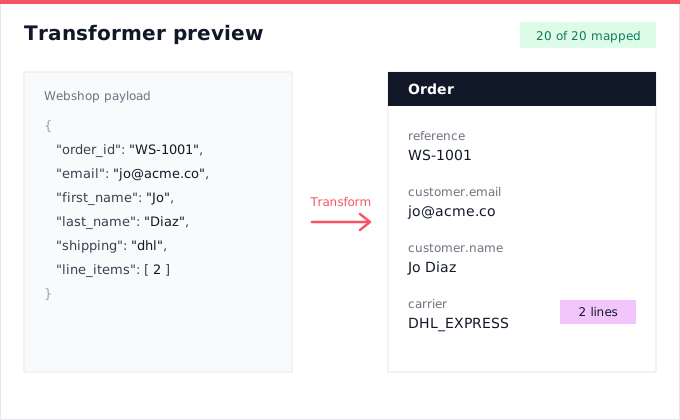
Start with one order.
Map one order from intake to delivery, including every handoff.
Classify each manual step as a standardization, integration, automation or orchestration gap.
Close the orchestration gap first. It is where most of the cost sits, and it makes every other fix worth more.
Map one order flow with us.
A 45-minute Integration Gap Review. We trace one real order from intake to delivery and send you the gap map with a validated saving, whatever you decide.
- Every handoff in one order flow, mapped
- Each manual step classified as a standardization, integration, automation or orchestration gap
- A validated saving, checked against the real order
- A clear first move, with or without Atomyx
